Feed the Wolf
My interest in hockey began, like that of many Americans of a certain age (ahem), with the 1980 U.S. Olympic hockey team.
The “Miracle on Ice” had everything a good underdog story requires. A group of college players faced the dominant Soviet national team at the height of the Cold War and won a game no one expected them to win. And then they came back in their final game against Finland to win the gold medal. I was hooked.
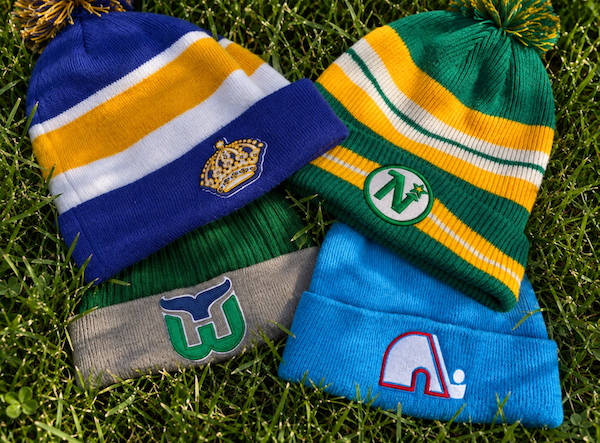
Hockey stayed with me. First, owing to my SoCal roots, it was the Los Angeles Kings, and after moving the East Coast in high school, the Washington Capitals. I also developed an appreciation for the logos that marked the era, which inspired my collection of ’70s pom hats.
Classics in the Lineup
The Kings are represented, of course. So are the Minnesota North Stars (now Dallas Stars) and the Quebec Nordiques (Colorado Avalanche). (If anyone has a lead on a California Golden Seals toque, please contact me .) However, the undisputed star of this group is the Hartford Whalers; their new identity (Carolina Hurricanes) had no hope of competing with one of the best logos in sports – ever.
But what has always interested me about the Miracle on Ice was not simply that they won. It was how they won.
The Whole Is Greater Than the Sum of Its Parts
Coach Brooks did not assemble the collection of players who looked best individually. He built a team. The whole became considerably greater than the sum of its parts.
The movie Miracle really captures this idea. Coach Brooks repeatedly pushes his players beyond what they think they can do, including with the admonition to “feed the wolf”—the idea that the thing you consistently work at and strengthen is the thing that ultimately prevails.
A Little Help from Jerry West
I have written before about my appreciation for a good logo, with a little help from Jerry West. One simple image can represent something much larger than its individual elements. A good team works much the same way. Talent matters. Individual performance matters. But the best organizations create something that is not apparent from looking at any one person.
Maybe that is why I still like those old hockey logos. Each represents a team, a place and, increasingly, a piece of history. And each is a reminder that identity is built from individual parts but is not limited to them.
That is probably more philosophy than most people attach to a winter workout hat.
Read More: